

If you work a desk job, commute by car, and unwind on the couch watching Netflix, you are sitting anywhere between 9 to 12 hours every single day. You are not alone. Millions of people do the same thing and have been doing it for years. And honestly, most of them feel fine. They get up, go to work, sit all day, come home, sit some more, and repeat. Nothing seems obviously wrong.
But here is what the latest 2024 and 2025 research actually says about sitting all day and how long you will live. The short version is not great news. But here is the thing no one tells you. The damage is not permanent. Small changes add up more than you think. And the research gives us very specific numbers on exactly what you need to do.
Key finding from 2024-2025 research: People who sit more than 8 hours daily lose approximately 2 to 3 years of life expectancy compared to those who sit less than 4 hours daily. Sitting more than 11 hours daily increases death risk by 57 percent in older adults according to a February 2025 study published in the Journal of the American Heart Association.
How many years does sitting take off your life
The most comprehensive data on this comes from a massive 2024 meta analysis that combined data from the UK Biobank and the National Health and Nutrition Examination Survey. The researchers tracked tens of thousands of people over years and found that sitting more than 8 hours daily increased all cause mortality risk by 41 percent compared to sitting less than 5 hours.
But here is where it gets more specific. A February 2025 study published in the Journal of the American Heart Association focused on older women and found that sitting 11 or more hours daily increased the risk of death by 57 percent. That is not a small number. That is more than half.
Another study across 21 countries found that people who sat more than 6 hours daily had a 20 percent higher risk of death compared to those who sat less than 3 hours. The numbers are consistent across multiple large scale studies. More sitting equals higher mortality risk.
So how many years are we actually talking about. Population studies indicate that people who sit more than 8 hours daily lose approximately 2 to 3 years of life expectancy compared to those who sit less than 4 hours daily. The exact number varies by age, current health status, and how much physical activity you get. But the trend is clear and consistent.
Your daily sitting habits affect your personal lifespan estimate. See exactly where you stand.
Calculate My Life ExpectancyFree. No signup. Takes 2 minutes.
What actually happens to your body when you sit all day
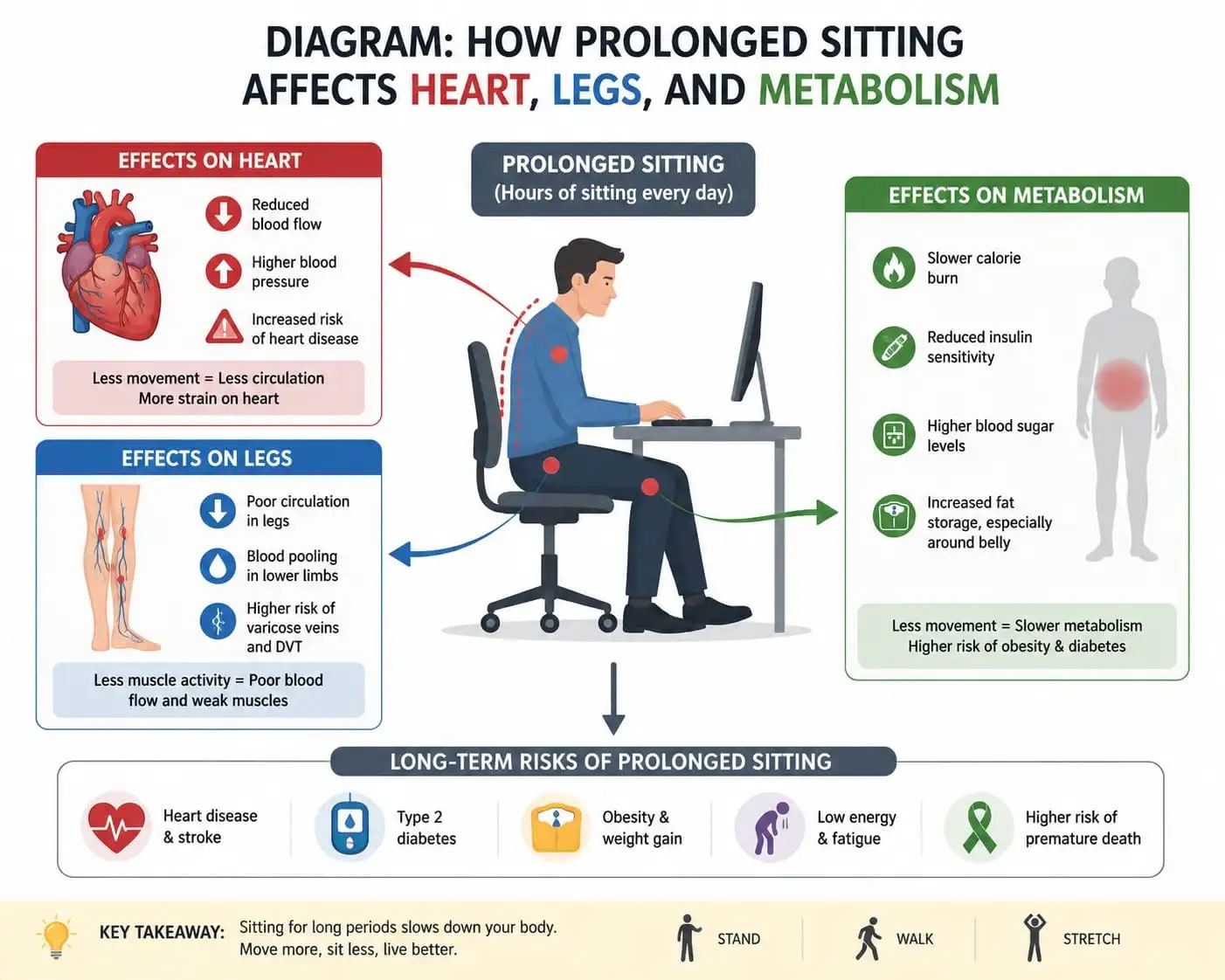
People often ask whether sitting all day is really that bad if they do not feel anything. The honest answer is that the damage happens slowly. You do not feel it until it has already accumulated. Here is what researchers have observed happening inside the body when someone sits for 8 to 12 hours daily for years.
Your muscles stop activating properly
After just 30 minutes of sitting, your large leg and gluteal muscles essentially shut off. They stop activating the way they are supposed to. Over time, this leads to muscle weakness, poor posture, and eventually back pain or knee pain. The human body was designed to move, not to stay in a seated position for hours at a time.
Your blood flow slows down significantly
The bend in your legs when you sit acts like a kink in a hose. It affects blood flow, especially in your lower body. Over time, this can contribute to blood vessels becoming stiffer. Stiffer blood vessels are a risk factor for high blood pressure, heart disease, and stroke. This is one reason prolonged sitting is so strongly linked to cardiovascular problems.
Your blood sugar and metabolism suffer
When you sit for long periods, your muscles are not taking up glucose from your bloodstream. This negatively affects your metabolism and blood sugar regulation. Studies show that people who sit for 8 or more hours daily have significantly higher rates of Type 2 diabetes, even if they exercise regularly after work.
Your risk of chronic disease increases across the board
UK Biobank research found that sitting more than 8 hours daily increased respiratory disease risk by 34 percent and cardiovascular disease risk by 72 percent. Other studies link prolonged sitting to higher risk of certain cancers, osteoporosis, depression, and cognitive decline.
Can exercise fix the damage from sitting all day
This is the question everyone really wants answered. You sit for 10 hours at work. Then you go to the gym for an hour. Does that cancel everything out. The short answer is yes but only partially.
Research from BMC Medicine in 2024 found that replacing just 30 minutes of sitting with light physical activity lowered death risk by 17 percent. Replacing 30 minutes of sitting with moderate to vigorous activity lowered death risk by 35 percent. That is significant. Exercise clearly helps.
Even 30 minutes of walking for pleasure reduced mortality risk by 3.5 percent. So any movement is better than no movement. The more intense the activity, the greater the benefit.
But here is the honest truth that many fitness influencers will not tell you. Even people who exercise regularly but sit for 10 to 12 hours daily still have higher mortality risk than sedentary people who naturally sit less. Exercise helps a lot. It reduces your risk significantly compared to being sedentary and inactive. But it does not completely cancel out the damage from sitting 10 or more hours daily. The best approach is to both reduce sitting time and exercise regularly. You cannot outrun a sedentary lifestyle entirely, but you can reduce the harm substantially.
See how combining movement with exercise affects your personal life expectancy estimate.
Try the Free CalculatorHow much sitting is too much and how often should you move
Research suggests that sitting more than 8 hours daily is where the risk really starts to climb. Sitting more than 11 hours daily appears to be the danger zone where mortality risk increases dramatically by 57 percent according to the JAHA study.
So what should you actually do. Columbia University researchers studied different movement patterns and found that taking a 5 minute movement break every 30 minutes improved blood pressure and blood sugar management more effectively than longer but less frequent breaks.
Even taking a 5 minute break every hour helped with blood pressure and mood. It is not as good as every 30 minutes, but it is significantly better than sitting for 3 to 4 hours without moving at all.
The goal is not to stand all day. Standing all day has its own problems including varicose veins and back pain. The goal is to avoid doing any one thing for too long. Sit for 30 minutes, stand or walk for 5 minutes. Repeat. That pattern appears to be the sweet spot based on current research.
Practical steps you can take starting today: Set a timer for every 30 minutes. Stand up, stretch, walk to the kitchen or bathroom. Even 2 to 3 minutes helps. If you work from home, consider a standing desk or a balance board. If you work in an office, use the bathroom on a different floor or take a lap around the building after lunch. Small changes compound into meaningful results over time.
The bottom line. Should you worry about sitting all day
If you sit 10 or more hours daily, the research is clear. Your mortality risk is higher than someone who sits less. Denying this does not help. But panicking does not help either.
The good news is that the damage is not permanent. The human body is remarkably adaptable. Studies show that people who reduce their sitting time and increase movement see improvements in blood pressure, blood sugar, and mood within weeks.
You do not need to go from sitting 10 hours to sitting 4 hours overnight. That is not realistic. But you can take a 5 minute walk every hour. You can use a standing desk for part of the day. You can pace while on phone calls. You can park further from the store entrance. Small changes add up. Progress beats perfection.
The research gives us clear numbers. Sitting 8 or more hours daily increases mortality risk by 20 to 40 percent. Sitting 11 or more hours increases it by 57 percent. But replacing even 30 minutes of sitting with movement reduces death risk by 17 to 35 percent. You have more control than you think.
Your lifestyle choices matter more than you realize. See how your daily habits affect your personalized lifespan estimate.
Calculate My Life Expectancy